
EN ISO 20471 is the international standard for high-visibility clothing — garments designed to make the wearer visible in daylight and in vehicle headlights at night. It defines three visibility classes based on the minimum areas of fluorescent background material and retroreflective tape, and sets requirements for colours, tape performance and placement. The class describes the garment, not the fabric or the tape alone.
The three visibility classes
The higher the class, the more visible material the garment must carry. Class 3 offers the highest visibility and is required where traffic moves fast or risk is high (roadworks, highways, airports); class 1 marks the lowest permissible level.
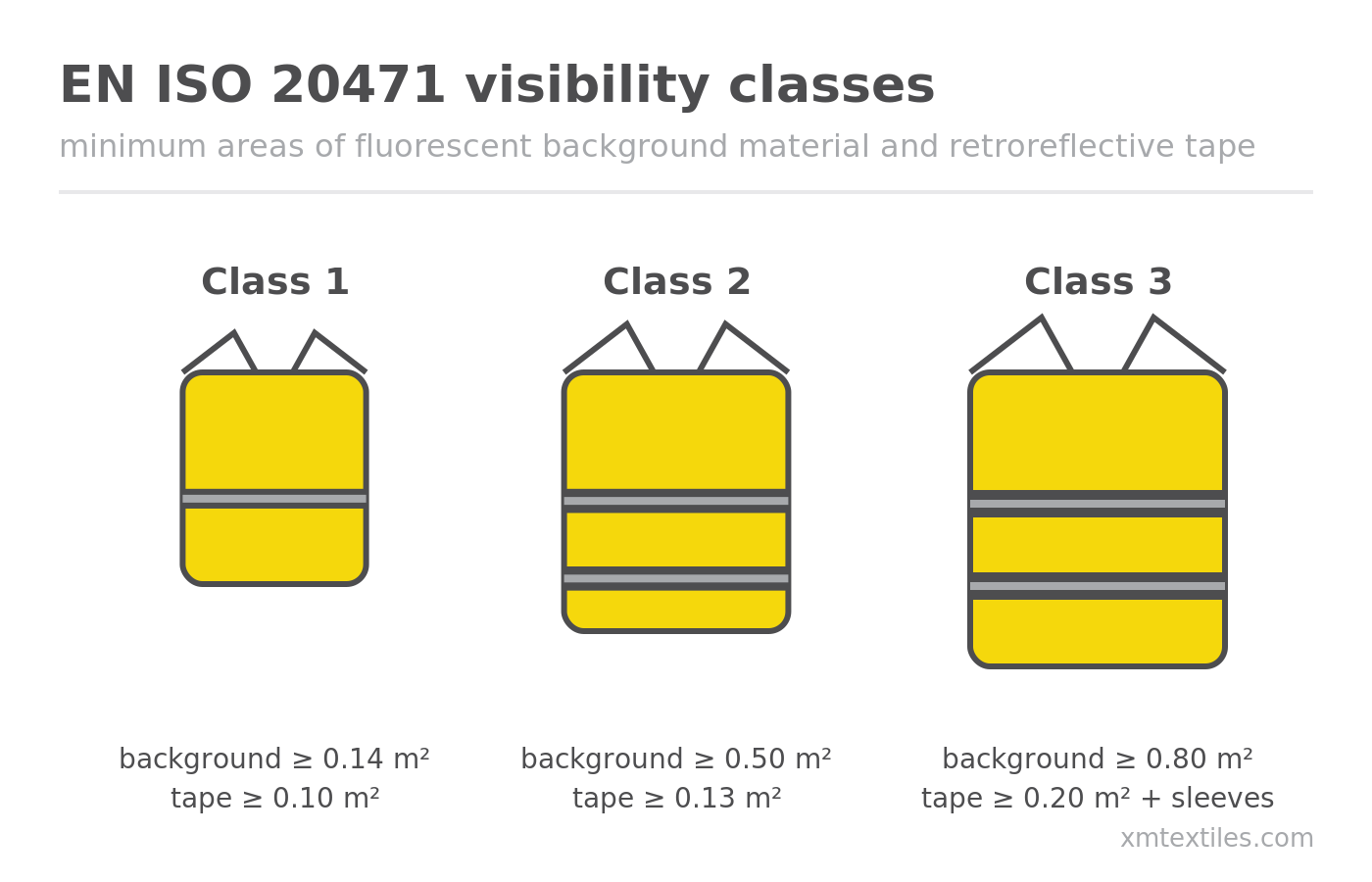
| Class | Background material | Retroreflective tape | Typical garments |
|---|---|---|---|
| Class 1 | ≥ 0.14 m² | ≥ 0.10 m² | Harnesses, trousers as part of an ensemble |
| Class 2 | ≥ 0.50 m² | ≥ 0.13 m² | Vests, waistcoats |
| Class 3 | ≥ 0.80 m² | ≥ 0.20 m² | Jackets, coveralls (must have sleeves or long legs with bands) |
Colours of the background material
Only three fluorescent colours are permitted for the background material: fluorescent yellow, fluorescent orange-red and fluorescent red. The standard defines exact chromaticity and luminance limits, and the colour must stay within them after the rated number of washes.
Requirements for the reflective tape
Retroreflective tape must meet a minimum coefficient of retroreflection (R′ ≥ 330 cd/(lx·m²) for new tape) and keep performance after washing, rain and abrasion tests. Bands must be at least 50 mm wide and placed according to the design rules of the standard (continuous torso bands, sleeve and leg bands for higher classes). Wash durability differs by tape type — the rated cycles are stated in each tape’s TDS.
XM SilverLine reflective tapes are certified to EN ISO 20471 and available as sew-on and heat-transfer versions; for firefighter and FR garments there are flame retardant reflective tapes certified to EN 469.
EN 471 vs EN ISO 20471
EN ISO 20471 replaced the older EN 471 in 2013. The main changes: risk-based approach, stricter requirements for tape performance and colour durability, and removal of the separate tape performance levels — only the higher level remained. References to EN 471 in old tender documents should be read as EN ISO 20471.
FAQ
Can a vest and trousers together reach class 3?
Yes — if the combination is tested and certified as an ensemble, the areas of both garments count together.
How long does hi-vis clothing stay compliant?
Until the fluorescent colour or the tape performance falls below the limits — in practice, for the number of wash cycles stated on the garment label and in the tape TDS.
Is EN ISO 20471 required by law?
In the EU, high-visibility clothing placed on the market as PPE must be CE-marked under Regulation 2016/425, and EN ISO 20471 is the harmonised standard used to demonstrate conformity.
What about FR high-visibility clothing?
For workwear that must be both hi-vis and flame resistant, garments combine EN ISO 20471 with EN ISO 11612 (or EN 469 for firefighters) and use flame retardant reflective tapes.
Need certified reflective tape?
XM SilverLine tapes — EN ISO 20471 certified, stocked in Europe, sold by the roll.